Life in Season: Spring on Iowa Farms
April 1, 2026
By Haley Banwart
For Iowa farm families, spring is a season of both risk and renewal. During this brief but busy window, they’re caring for newborn animals, spending long hours in the field and making management decisions that will shape the entire year.
In this Q&A, three Iowa farm families share what spring looks like in their operations, the financial and emotional risks most people never see, and what they wish Iowa consumers knew about the food grown on their farms.
Meet the Farmers
|
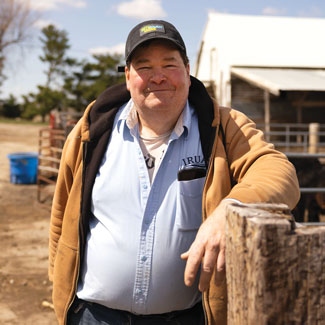
Dave Struthers
Collins, Iowa
Soybeans, corn, alfalfa, pigs, cattle
|
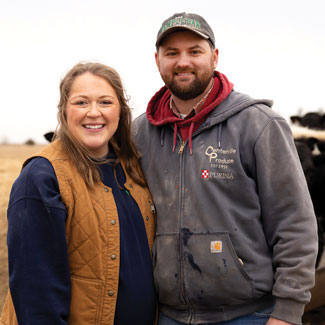
Donnie & Emma Conway
Melrose, Iowa
Cattle, corn, soybeans, hay
|
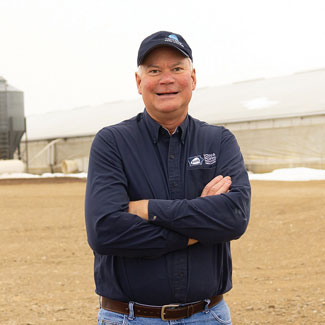
Dean Frazer
Conrad, Iowa
Pigs, corn, soybeans
|
Q: What does a “normal” day look like for you during the spring season?
“If it’s good planting weather, I’m up early, eating on the go. I feed the pigs before I head to the field. I farm alongside my younger brother and my nephew. We run two planters. My nephew handles soybean planting, and I’m in charge of planting corn.”
- Dave S.
“Springtime is when we start calving, which can mean late nights and long hours keeping an eye on our herd. We try to be as hands-off as possible — let the cows be cows and hope for minimal intervention. Our mornings start with getting our two children ready for school and daycare. Then it’s chore time. The cows are always our priority before we head to the field.”
- Donnie & Emma C.
“A typical day includes loading pigs around 6 a.m., chores, then heading to the field to plant corn, soybeans or seed corn. We run two planters simultaneously and spray our own crop protection products immediately after planting.”
- Dean F.
Q: What’s one part of your job most people don’t realize takes as much time or energy as it does?
“Crop selection and marketing. It takes considerable time and attention to select our crop mix, choose the right hybrids and determine when and where to sell them at a profitable price. As farmers, we track prices, decide how much to sell and must always be ready to pivot.
It’s not like having a salaried job with a set pay scale. There are no guarantees. Our income depends entirely on the prices we get and how much we produce.”
- Dave S.
“All the operational planning. We evaluate our decisions from a whole farm level to maximize what we’re doing with our cattle and row crop enterprises from both an environmental and economic standpoint. For example, we like to experiment with incorporating other crops — like milo — as an additional forage source for our cattle to graze during the winter.
And machinery maintenance. Oftentimes, you’re a mechanic first and a farmer second.”
- Donnie & Emma C.
“Scheduling and logistics take far more time than most people realize. We schedule pigs to packers two to three weeks out, while weaned pigs arrive every three to four weeks from our sow cooperative. Coordinating people, pigs and equipment, especially in spring and fall, can get hectic.”
- Dean F.
Q: Farming is sometimes a solitary job, but no one does it completely alone. What does your support system look like, and how important is it to your work and well-being?
“My wife takes care of our home, makes sure I’m fed and helps with logistics. My brother, nephew and I all share responsibilities, and I can rely on them. That support system is really important to keeping things going.”
- Dave S.
“We’ve had a working relationship with a neighboring farm family since high school, and that partnership has continued over the years. We’re now moving toward sharing equipment and other resources, which is a big step forward for both of our operations.
Emma’s parents are also a huge help, whether it’s watching the kids or doing chores like cutting brush or raking hay. And we’ve been fortunate to have the support of a part-time hired hand.”
- Donnie & Emma C.
“The family supports each other and works well together. Before that, I leaned on ag friends who understood the stress. I’ve also worked with the same veterinarian for more than 30 years, and in pork production, you build strong relationships with suppliers and fellow producers. You rely on each other in this close-knit industry.”
- Dean F.
Q: What does environmental stewardship look like for your operation?
“Stewardship means ensuring the land remains productive for generations to come. I have a son who would like to farm someday, and other nephews too, so we want to make sure it’s left in good condition for them. That includes paying attention to water and air quality, utilizing nutrients on a calculated basis and reducing soil erosion.”
- Dave S.
“We’ve used programs like EQIP (Environmental Quality Incentives Program) to help us cost-share for improvements such as cross-fencing, installing water systems and better utilizing our grass through managed grazing. We’ve also invested in conservation practices, such as building terraces and incorporating greater crop diversity into our rotation.”
- Donnie & Emma C.
“Stewardship is part of our daily work. We raise our own pigs and use their manure to fertilize much of our corn and soybean acres, in accordance with DNR regulations. That’s sustainability in action. We also use no-till and strip-till practices, cover crops, waterways, buffer strips and terraces to reduce erosion and protect water quality.”
- Dean F.
Q: What do you wish consumers knew about the farms behind their food?
“There’s a pride instilled in how we care for our animals and the products we produce. In our operation, most of our corn goes to feed our hogs and cattle, or to produce ethanol. Our soybeans are processed into soybean meal that’s then fed to our hogs. Agriculture creates a supportive, sustaining cycle.”
- Dave S.
“It’s important to remember that even larger operations are also family-run and owned, often with multiple generations involved. Different production practices all have their place in our industry because each meets the different demands of everyday families.”
- Donnie & Emma C.
“Most of the protein people buy comes from multigenerational family farms like ours. Despite growth, we still rely on the same husbandry skills passed down through generations to care for our animals. We also commit to the Pork Quality Assurance (PQA) program to ensure consumers receive a safe, high-quality product.”
- Dean F.
Q: With all the different challenges outside your control, what motivates you to keep farming?
“I enjoy watching creation. Raising an animal, raising a crop from seed and watching it flourish, and knowing it’s providing food and fuel not just for my family but for several hundred people. I also enjoy the flexibility that comes with farming.”
- Dave S.
“We love working with livestock. There’s nothing better than seeing a fresh baby calf on green grass. And our kids love it, too. We enjoy taking them along with us and building something together as a family, something that can be theirs one day if they choose.”
- Donnie & Emma C.
“Working alongside my family every day is a big motivator. Farming is also about legacy. My family has been doing this for more than 155 years, and my son and daughter-in-law are continuing the tradition of hard work and giving back to the community, just as the generations before us.”
- Dean F.