No Field, No Problem.
January 1, 2026
By Gretchen Westdal Centers
Imagine traveling back in time and telling a 19th-century farmer that one day they won’t need to rely on the sun, rain or soil to grow their crops. They’d probably laugh at you and get back to using their wooden plow. Technological advancements in farming have made so much of farm work less dependent on finicky factors. True, many farmers still deal with ever-changing weather and pests, but with hydroponic farming, growing hearty, thriving crops can be done indoors with a few key elements.
Hydroponic Know-How
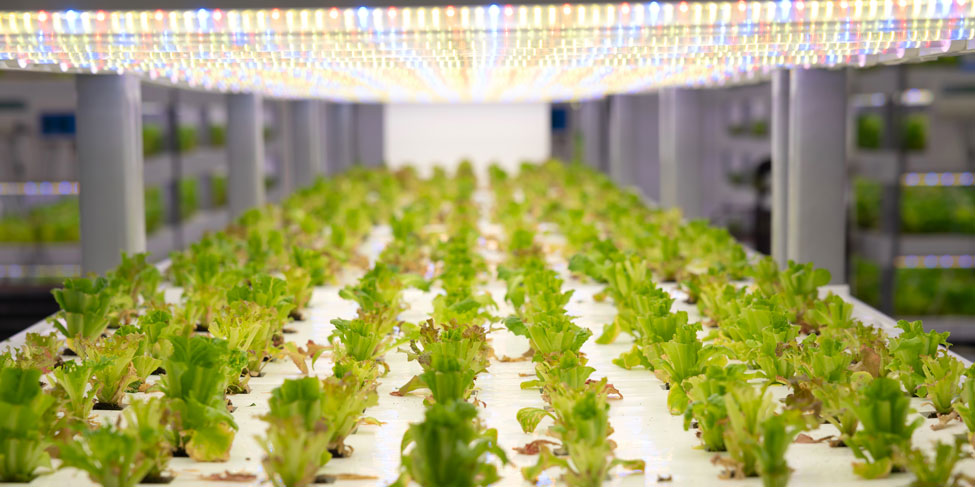
Hydroponic farming is a method of growing plants without soil, using a nutrient-rich water solution to deliver all the essential minerals directly to the plant roots. Instead of drawing nutrients from the soil, the plants are supported by an inert medium such as perlite, coconut coir, vermiculite or rockwool. This medium — some of which are naturally occurring and others synthetic — helps anchor the plant while allowing oxygen and moisture to circulate freely.
The key advantage of hydroponics is control. Farmers and growers can precisely manage water, nutrients and light, allowing plants to grow faster and often produce higher yields than traditional soil farming. It’s a sustainable and environmentally friendly option that uses up to 90% less water than standard agriculture, and it enables year-round growing in indoor or greenhouse environments regardless of weather or soil quality.
Hydroponic farming allows for more opportunities for people to engage with agriculture. From urban farming to supplying food deserts, hydroponics is an efficient and effective way to feed more people with the fresh foods that so many cannot access.
Wesley Life Meals on Wheels
Nowhere is this more apparent than at the Prairie Meadows Hydroponic Farm operated by and located on the campus of WesleyLife Meals on Wheels. WesleyLife’s Meals on Wheels program has long been a lifeline for older adults in central Iowa. In 2023, that mission expanded — literally underground — with the launch of the hydroponic farm beneath the Meals on Wheels campus.
“We’ve always been passionate about health and well-being,” says Shannon Draayer, executive director of community nutrition. “We wanted to grow our own food and produce fresh, local greens that go directly to the people we serve.”
The farm operates a vertical hydroponic system that maximizes indoor space and efficiency. “It’s a controlled environment — no soil, just nutrient-rich water constantly circulating,” explains Amanda Kanehl, head grower. “We harvest about 150 pounds of leafy greens a week — sometimes more. The system lets us grow nutrient-dense varieties that taste great, not just what can survive outside.”
Beyond providing food, the urban farm strengthens community ties. Volunteers help with planting, harvesting and packing greens for Meals on Wheels and the Food Bank of Iowa. “It’s amazing to see people connecting — students, retirees even corporate groups,” Draayer says. “They come together over a shared mission to nourish others.”
WesleyLife’s Meals on Wheels now serves around 930 clients, offering daily meal choices that include the greens grown on-site. “We had a woman call who hadn’t eaten for three days,” Draayer recalls. “When she finally received her meal, she cried. That’s why we do this — because we’re more than a meal. We’re a connection.”
Looking ahead, the team hopes to expand into retail and inspire others to explore urban farming.
 Good Food Fast
Started in 2017 by Clayton Mooney and cofounder Danen Pool, Clayton Farms began with a simple mission: “better food for more people.” Frustrated by the inefficiencies of traditional indoor farms — either too large and unprofitable or too dependent on middlemen — they set out to create a model that grows food close to consumers while owning the entire supply chain.
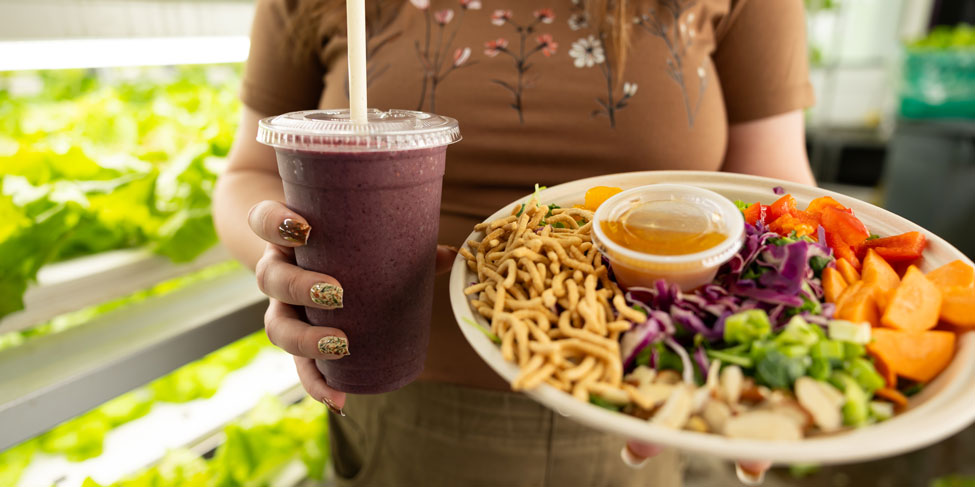
“We wanted to literally grow food that went directly to people,” Mooney explains. After years of developing their own hydroponic technology, they opened their first “farm-to-table” restaurant in Ames, where salads and smoothies are made from greens harvested just minutes before serving. The model took off, serving more than 100,000 customers in under two years.
At the heart of their success is a closed-loop hydroponic system that uses a fraction of the water of traditional farming. “For every month we grow food in our equipment, we save one year’s worth of water compared to traditional farming,” Mooney says. “That’s about three gallons of water saved per meal.”
Consistency and environment are key. “You can have the best growing technology in the world, but if the environment isn’t right, you won’t have healthy plants.” The team tightly controls light, humidity and nutrients to keep plants thriving 52 weeks a year.
Their commitment to sustainability extends beyond the farm. “We were awarded the highest sustainability award in Ames because everything we do — packaging, sourcing, operations — is designed to reduce waste.”
Looking ahead, Mooney envisions expanding into new markets, such as San Francisco. “If we can give people years back on their lives by replacing unhealthy fast food with fresh, local meals, that’s 200 million years given back to humanity. That’s what drives us.”