Bedrock of Bravery
October 5, 2026
By Gretchen Westdal Centers
Resilient. Strong. Weathered. All adjectives that can be associated with the boulders and rocks that dot Iowa’s landscape. These same adjectives can also describe our country’s courageous veterans and servicemembers. And Ray “Bubba” Sorensen knows something about both.
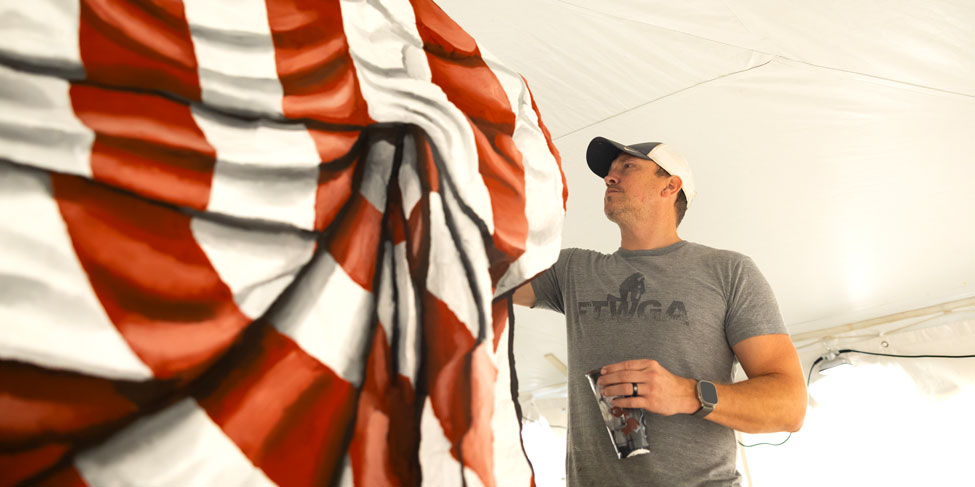
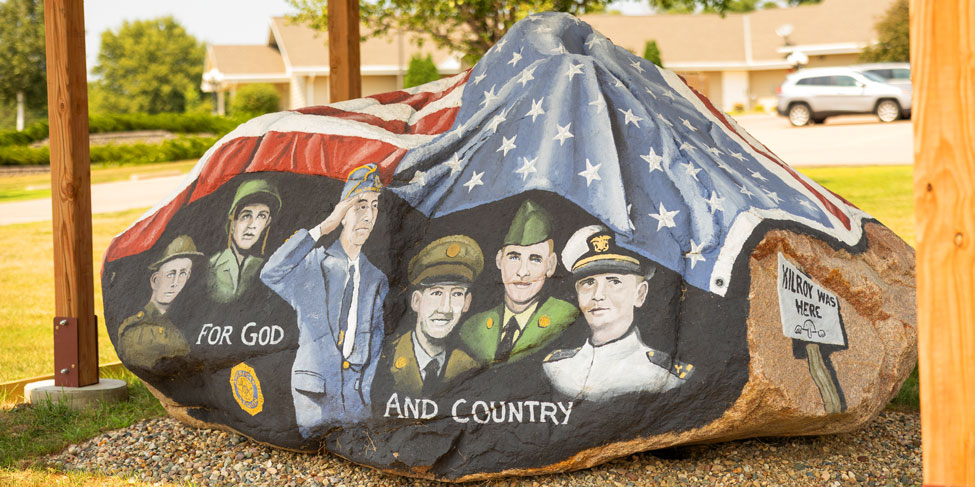
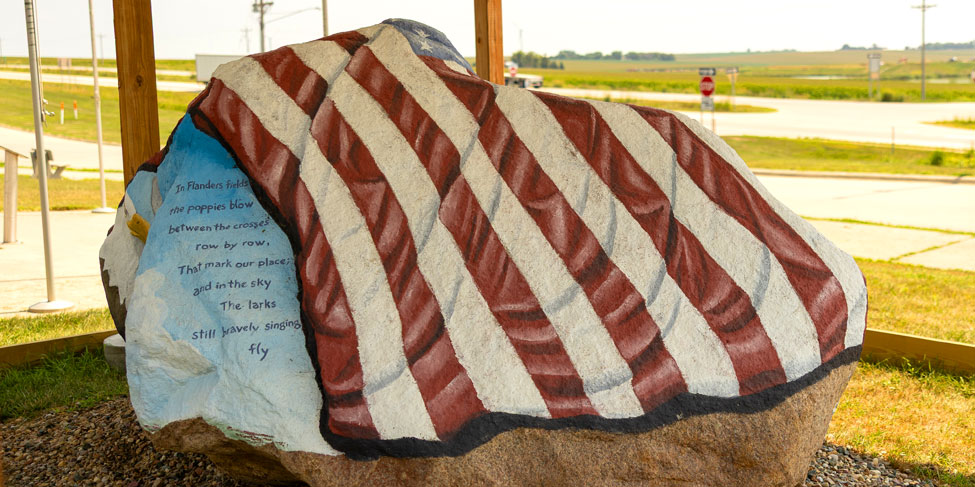
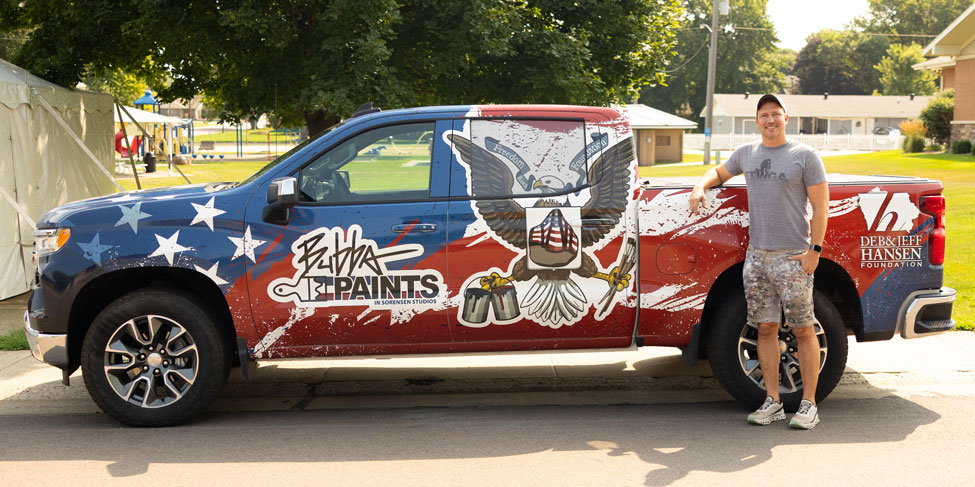
Sorensen is the artist responsible for The Freedom Rock. Found in all of Iowa’s 99 counties, these rocks feature vivid, moving murals depicting Iowa’s veterans and heroes. The first rock was painted in 1999, right around Memorial Day. Sorensen, 19 years old at the time, was fresh out of high school and felt called to do something to honor the sacrifices of the nation’s brave servicemembers and veterans.
That original rock, which is approximately 12 feet tall and weighs around 60–90 tons, sits in Adair County, along Highway 25, outside the small town of Menlo. Sorensen returns annually before Memorial Day to paint a new mural that will honor veterans and bring visitors to take in the visual stories he creates.
“Every hometown has a hero — or heroes — and their stories are begging to be told,” Sorensen shares. “Art comes in many forms. You can tell a story through a song, a painting, or by sharing photographs. There are a million ways to honor these folks, and mine has become mural painting on rocks.”
 From Fields to Freedom Rock
Growing up in Fontenelle, Sorensen participated in 4-H and showed cattle. And, like most kids in agriculture, he quickly learned about the resilience and patience that’s necessary for life on a farm or raising livestock. Those early experiences navigating situations beyond his control and the physical demands of farming helped shape his outlook on his future work.
“Being in a small town, you recognize the value of hard work — and hard work not for yourself or for recognition, but for something bigger than yourself,” says Sorensen. “I think that’s what a lot of farmers and veterans have in common. Growing up around that pull-yourself-up-by-your-own-bootstraps mentality is what shaped me in those early days.”
Honoring that commitment and sacrifice is what Sorensen still does today through his work on The Freedom Rock and Freedom Rock Tour. He is also a member of the Iowa House of Representatives for the 23rd District, which includes Adair and Madison counties and portions of Dallas, Union and Clarke counties.
He balances his time between painting murals and visual storytelling, representing his constituents, and promoting Iowa tourism and The Freedom Rock Foundation.
 From Small Town to Massive Mission
He, his wife, Maria, and often their three kids run The Freedom Rock and also have a graphic design and photography business. Now that he has completed a Freedom Rock in every county in Iowa and painted murals across the state honoring the men and women who have served, Sorensen has big goals.
“My biggest goal that I want to cross off the list is to get at least one Freedom Rock in all 50 states,” Sorensen explains. “Beyond that, I am working on a project called the Medal of Honor Murals along Highway 20, which runs coast-to-coast right through Iowa. It is officially the Medal of Honor Highway. We have over 3,500 Medal of Honor recipients, and I would like to paint freestanding murals along that entire highway honoring them.”
It’s a large undertaking. But he’s on his way. Sorensen just painted the first mural honoring Bud Day, a Medal of Honor recipient from Sioux City who was a prisoner of war in Vietnam.
As the U.S. celebrates its 250th anniversary, Sorensen’s work feels even more significant in commending and remembering all those who’ve served and given their lives to protect the country.
“History tends to forget or push people aside over time,” Sorensen notes. “My goal is to have that face or those eyes staring back at you from the rock for years to come, bridging the generational gap. A World War II hero may have passed on, but now he is looking back at his grandson, prompting the family to talk about his service.”
 Creating Community
Throughout the state, The Freedom Rock becomes a community gathering place for residents and veterans to pause, remember and reminisce about those depicted on the stone or of other veterans they cherish. Grandparents sharing with their grandkids about their service. Veterans connecting with one another to empathize about their experiences.
These rocks are visual representations of the magnitude of war and conflict, of the physical and emotional toll it takes on those who serve. The size and strength of the stone remind the viewer of the strength necessary to enter a conflict and bear the responsibility of service.
Sorensen shares an impactful interaction he had while painting a particular mural. “There was one specific story involving a man who was both a farmer and a veteran,” begins Sorensen.
“He came out very late one night while I was painting. He sat down and didn’t say much at first. When he felt it was the right time to talk, he told me that he had seriously contemplated taking his own life. He had come back from service with a lot of mental scars and felt like he returned to a different country.”
“He came out to the rock when nobody was around, sat there, looked at it. He thanked me for bringing his experience to life, which made him feel remembered and seen. That hit me very hard because it validated exactly what I wanted to do. I wanted the rock to bring healing and to bridge the past, present and future. War is not glorious, but we must remember our history and the sacrifices made to preserve our freedoms. These men and women who put their lives on the line are worth remembering.”
 A Tour to Honor
There are 100 different rocks to visit in Iowa, with 100 different faces, images and memories to see and treasure. Travel Iowa has a complete checklist that people can use to find the location of each rock and mark off the ones they see. There’s also a helpful interactive map that provides suggested driving routes, allowing viewers to see multiple rocks in one trip.
When asked what Sorensen hopes people take away from visiting a Freedom Rock, he says:
“A sense of pride in our history. This country is very young, and it was built on the backs of farmers who set down their pitchforks and picked up rifles — men who literally didn’t have shoes and left bloody footprints in the snow. It’s about remembering where we came from and the actual history, even the parts that aren’t good or that we’re not proud of. Remembering all of it shows how we developed into something to be proud of.”