Farm Family Folklore
July 23, 2026
By April Pearson
Moeckly Farms in Polk County has eight generations’ worth of fascinating farm family history. From accidentally starting a silage business to raising cattle rescued during World War II to somehow ending up with a baseball field in the middle of their cornfield — some stories you must read to believe.
 The Original Plot
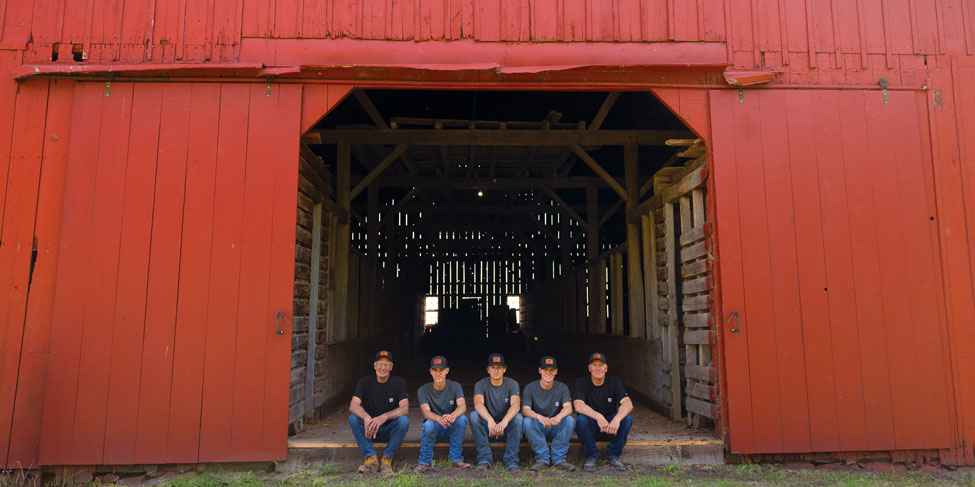
The Moeckly Farms story began in the late 1840s, when Konrad Möcklī and his son Johannes immigrated to the U.S. from Switzerland. They braved their first Iowa winter in a covered wagon, bought a plot of land in 1854 and built a beautiful red barn in 1876 that still stands today. Johannes and his wife went on to have six kids, “and every generation’s farmed non-stop since then,” says Tyler Moeckly, who works alongside his wife Anna, parents Paula and Steve, and kids Jon, Jacob and Nick.
The Moecklys grow commercial corn and soybeans, as well as seed corn and soybeans. While it’s more work creating a higher-yielding hybrid seed, it’s worth it. “Instead of farming more acres, you can get more revenue per acre producing seed — so we kind of like that,” says Tyler.
They also have a custom silage operation, which they didn’t exactly set out to do. “In the beginning, we just did it for our own cattle, but then we got a better forage harvester, and soon we were harvesting forage for 20 different places,” says Tyler. “It kind of started a business that we didn’t really intend to start, but we’re still doing it!”
Their harvester can process 80 acres per day, creating corn silage “confetti” that then passes through a roller mill to make it more palatable. The crushed forage sits in a bunker silo to ferment for months, allowing the anaerobic bacteria to convert the sugars into protein. The process is efficient, the feed is nutritious, and the cattle love it. Tyler says, “In the winter, the silage is still warm and moist from going through the fermentation process. The steam just rolls off it. So, it’s kind of nice for the cattle to eat on a cold day.”
A Cow Tale
During WWII, Winston Churchill gave the order to burn all crops and slaughter all cattle in England if Germany invaded. To prevent the extinction of rare British White Park cattle, a small herd was shipped from Britain to the U.S. as a precautionary measure. Originally sent to the Bronx Zoo in New York City, the cattle were eventually moved to King Ranch in Texas, where they remained as a closed herd for 40 years.
“In 1981, King Ranch was running out of room, so they invited my mom and dad to go down there, take a look and buy some cattle if they wanted to,” says Steve. They did want to. In fact, Marylin and John Moeckly bought the entire herd of British White Park cattle and brought it up to Iowa. “We started breeding them for the purebred market. And, we started selling cattle all over the continent.”
A few years later, Marylin went to Scotland and bought a purebred White Park bull to introduce a new bloodline into British White Park cattle that had been inbred for four decades. It had to be quarantined for six months before joining the herd in 1984, but was it worth the wait? “We finally got the Scottish bull home and used him for a couple of years, but we found out that the original herd’s genetics were better than the new bull’s offspring,” says Steve. So, the Moecklys sold the Scottish White Park bull and its offspring to The Nature Conservancy.
They also sold some of their British White Park cattle to Seed Savers Exchange in 1988, but for a different reason. In the 1980s, the breed was considered “critically endangered.” Seed Savers — a nonprofit dedicated to preserving America’s culturally diverse food legacy — bought the cattle to protect them for future generations.
British White Park cattle are known for beautiful markings, excellent flavor, good marbling and ease of calving. “The most important thing about them is that they’re good mothers,” says Steve. “Back in the old days, in England, they ran wild. So, they have this wild instinct to survive. You want to get out of their way when they have a calf, because she can take care of it better than anyone else. And she wants you to know that.”
In its peak cattle-producing days, Moeckly Farms had more than 100 head of purebred White Park cattle and was known as “The Iowa Home of Registered White Park Cattle.” Though they’ve pivoted and diversified over the years, the Moecklys still raise White Park cattle as part of their calf-cow operation.
 A Wild Pitch
In 2021, an opportunity for the Moecklys came out of left field. “We got a note on the front door that a location scout had been there, looking at our property for a project. So, I gave her a call,” says Anna. “She said, ‘Hey, I’m going to bring two guys out to your farm. I think it’s perfect for what we’re looking for.’ I rolled up to our meeting, having no clue what was going on, and I realized that Mike Schur and Morgan Sackett were standing at our house, looking at our field.”
Schur and Sackett are big hitters in Hollywood, having collaborated on “Parks and Rec,” “The Good Place” and “Man on the Inside.” And they wanted to put a baseball field in the Moeckly’s corn field for a “Field of Dreams” revamp.
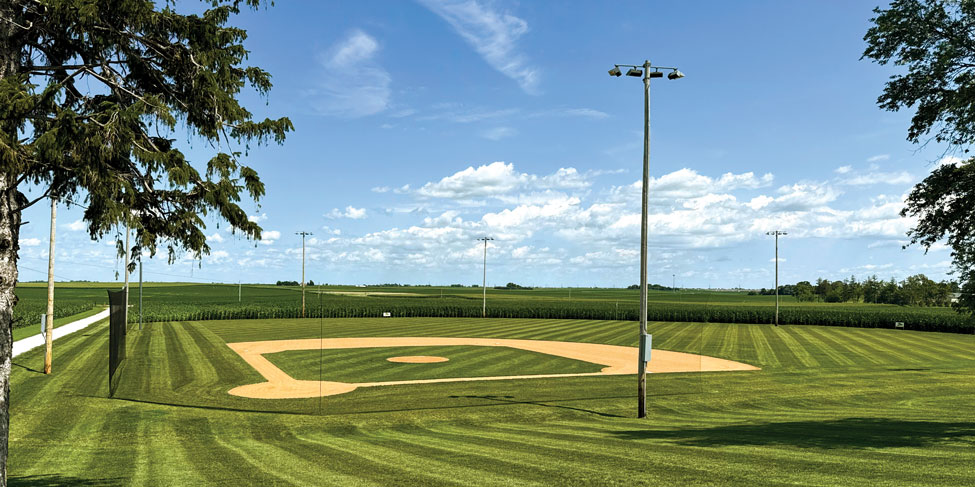
They pitched the idea to Anna, and the family loved it. Once things got moving, they moved fast. “They started production of the field-dirt work right away,” says Anna. “It was a really neat process. We dedicated three acres of crop ground, so it’s the size of a major league baseball field. It has state-of-the-art lights from Musco Lighting. They didn’t really spare any expense.”
And then, as quickly as it started, it stopped. Production halted due to economic conditions in post-COVID Los Angeles, and even though Anna’s still in contact with the production team, it’s uncertain whether the project will ever happen. “Hopefully there’s a show in the future, but if not, we don’t have any regrets. I think it’s been a neat part of our story to tell.”
For now, the Moecklys are using the baseball field for community family fun nights, yoga in the ballpark, baseball practice for local teams and other events. “It really is magical,” says Anna. “It’s an unparalleled experience when you’re out there in the summer, and the corn’s 10 feet tall, and the lights are on, and it’s just, wow, it’s breathtaking.”
The Story Continues
Going on nine generations, Moeckly Farms is still growing — corn, soybeans, cattle and stories worth telling. Anna finds it especially heartwarming to have three generations working the same ground their family did nearly 200 years ago. She says, “I think our key to success is respect for and love of one another, and knowing that we need to honor our past.”
Iowa’s Best Burgers
Arcadia, a restaurant in Polk City, offers a smash burger with cheese, caramelized onions, pickles, signature Arcadia sauce — and delicious, fresh beef from Moeckly Farms.
“Our friends at Arcadia wanted to invest locally and source quality ingredients closer to home,” says Anna. “They needed beef, and it just so happened that we had beef, so we decided to partner up.”
The partnership paid off. Arcadia won the Des Moines Register’s 2026 Burger Bracket and was a top-10 finalist for the Iowa Beef Industry Council’s Best Burger in Iowa for the second year in a row.
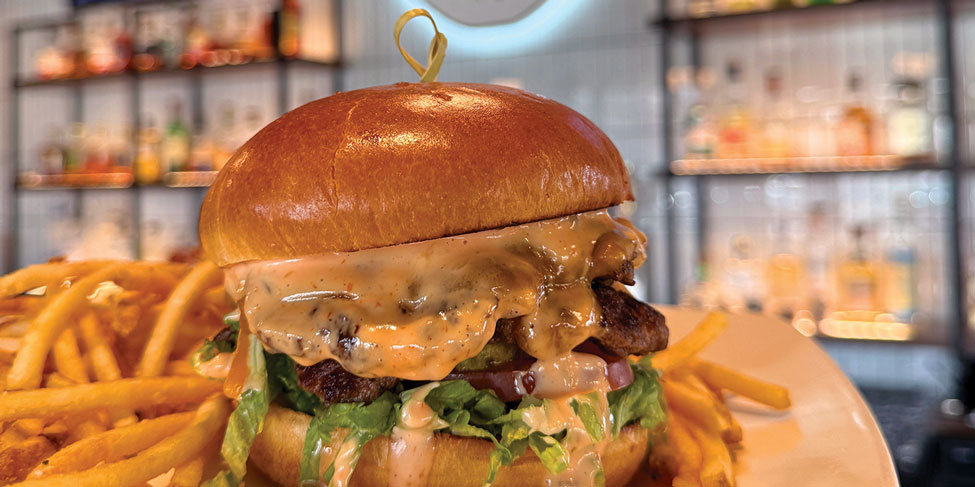 Photo courtesy of Iowa Beef Industry Council