From Farm Fields to Faucets
July 23, 2026
By Darcy Maulsby
Imagine turning on the faucet — and nothing comes out.
No clean drinking water. No shower. No water for the garden or lawn.
Water is so interwoven into daily life that it’s easy to overlook — yet rural and urban Iowans depend on each other for clean water.
“Water quality is also important for recreation, tourism and our economy,” notes Rebekah Jones, communications director with the Iowa Agriculture Water Alliance (IAWA).
In recent years, IAWA teamed up with Exile Brewing Company in Des Moines for a new beer made with all-Iowa ingredients for the “Born Here, Brewed Here” campaign. For each case of beer sold, $5 went toward water quality improvements around Iowa.
“You can’t have good-tasting beer without clean water,” Jones (pictured above) says. “Partnerships like this bridge rural-urban connections.”
Photos courtesy of Des Moines Water Works
The Des Moines Water Works (DMWW) is strengthening these connections, too. As a contract operator for Central Iowa Water Works, DMWW provides water to 600,000 residents in a four-county area.
DMWW collaborates with many partners, including Practical Farmers of Iowa and Iowa State University Extension, which offers conservation-focused landowner education programs. In 2022, DMWW helped purchase a seeder to increase cover crop acres and improve water quality in the Des Moines and Raccoon River watersheds. Heartland Co-op has used this machine to seed tens of thousands of acres of cover crops for farmers and landowners.
DMWW has also teamed up with Iowa Learning Farms for “Conservation on Tap.” During these in-person gatherings, farmers, landowners and other Iowans can come together to discuss conservation practices and ask questions.
“We view water quality as a joint responsibility,” says Melissa Walker, DMWW communications and outreach manager. “We all have a role in this.”
 Turning Conservation into Action
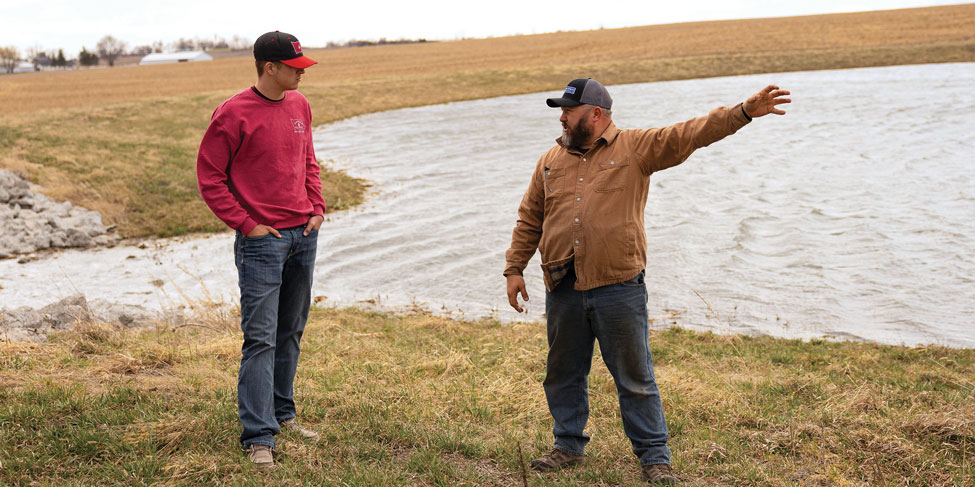
To keep these conversations going, DMWW took its annual legislative event on the road in 2025. DMWW board members, Iowa legislators and staff, and representatives from IAWA, Polk County Public Works, the Beaver Creek Watershed and Heartland Co-op visited Nick Helland’s farm to learn about conservation practices that protect water quality.
“It’s critical to keep the lines of communication open,” says Helland, whose family has farmed north of Des Moines near the junction of Polk, Boone and Story counties since 1861. “We want to show people what’s possible with conservation on the farm.”
The Helland farm proves that cleaner water isn’t someone else’s responsibility. It starts locally — one field, one partnership at a time. What began as a shift to no-till farming in the 1990s has evolved into a full-scale conservation effort.
The Helland family has incorporated cover crops (including cereal rye) on their acres since 2012. The cover crops’ roots improve soil structure and water infiltration. Allowing the soil to absorb more water helps control runoff and erosion.
Since 2021, the Helland family has also installed eight bioreactors and saturated buffers along their field edges to help filter water naturally before it enters the Des Moines watershed. “We’ve kind of become a conservation show farm,” says Helland, who received the Iowa Soybean Association’s (ISA) 2026 Environmental Leader Award.
Saturated buffers and bioreactors are part of Iowa’s innovative “batch and build” model. Coordinated by the Iowa Department of Agriculture and Land Stewardship, this system expedites the installation of edge-of-field conservation practices across multiple farms, accelerating water quality improvements.
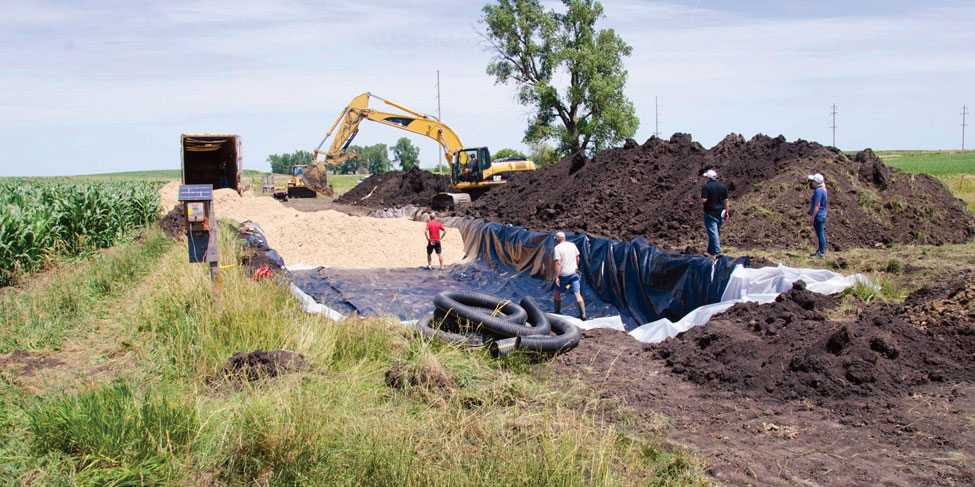 Saturated buffers divert ag tile drainage water into grassy zones along the edge of the field, where soil microbes naturally remove nitrates before the water reaches streams. Bioreactors are buried trenches filled with woodchips. Ag tile drainage water flows through the bioreactors, where microbes help remove nitrates.
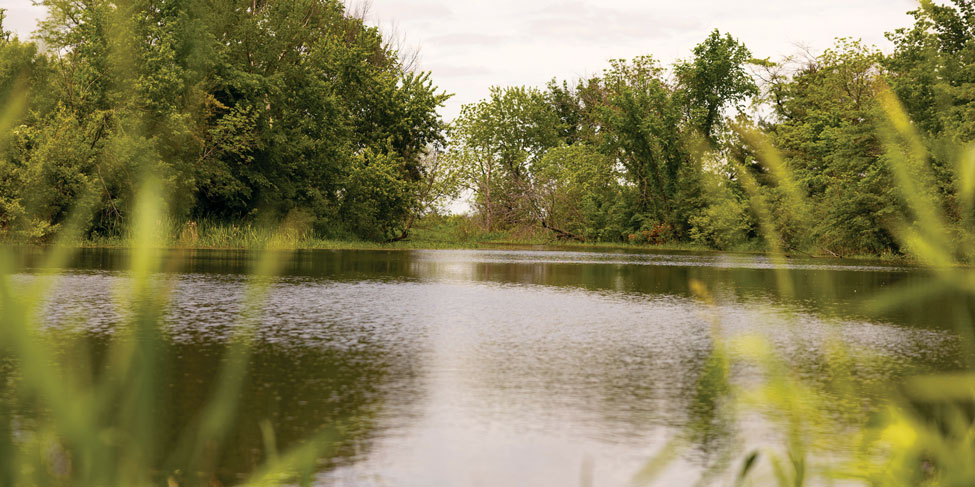
In 2024, Helland restored a 3-acre wetland near Big Creek. The wetland helps remove excess nitrates from 170 acres of cropland, serving as a critical last stop for water heading toward Des Moines.
In years past, Helland battled flooding that repeatedly damaged the area after heavy rains. Today, native plants and wildlife thrive there. “This used to be a pain point,” Helland says. “I devoted a lot of time to fixing washouts there. Switching from this high-maintenance farming to conservation has made the rest of my farm more efficient.”
In 2026, Helland is partnering with ISA’s conservation team to restore an oxbow. This project will remove sediment from an old stream meander to restore natural flood water storage and create habitat for the Topeka shiner, a tiny fish that is listed on the federal Endangered Species Act.
“ISA has really stepped up when it comes to conservation and water quality,” says Helland, who is also working with ISA to add pollinator habitat on his land.
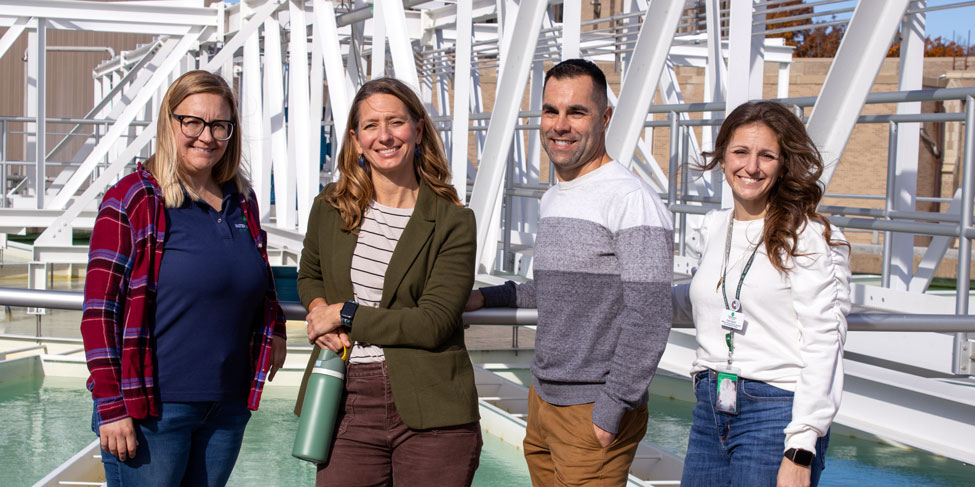 Photo courtesy of City of Cedar Rapids
Cedar Rapids Promotes Sponge Cities, “Sponge Farming”
ISA has also teamed up with the City of Cedar Rapids since 2017 to promote conservation practices that reduce runoff and nitrates in the Middle Cedar River Watershed. This region includes 1.5 million acres spanning 10 counties in eastern and east-central Iowa. More than 70% of this area is dedicated to row-crop production.
“Ag is central to who we are as a community,” says Mary Beth Stevenson, watersheds and source water program manager with the City of Cedar Rapids. “Cedar Rapids is an urban hub for ag processing, with plants like Cargill, ADM and Quaker Oats. Ag does bring environmental challenges, though, with nitrates that impact the drinking water supply.”
The City of Cedar Rapids coordinates water monitoring across 60 locations in seven Iowa counties across the Middle Cedar River Watershed. “We’ve been tracking nitrates in the Cedar River for more than 20 years,” Stevenson notes.
The City of Cedar Rapids also leads the Cedar River Source Water Partnership (CRSWP). The CRSWP is a $16 million project funded by United States Department of Agriculture – Natural Resources Conservation Service (USDA-NRCS) and 13 partners.
The CRSWP works to reduce downstream flood risk, improve wildlife habitat and support farmers who want to implement more conservation on their acres. “The end goal is to reduce nitrate to manageable levels, so it doesn’t negatively affect drinking water,” Stevenson says.
Funding through CRSWP helps fund a conservation agronomist position within a local ag cooperative. “We’re grateful for the farmers who have teamed up with us to try new conservation practices that build healthy, resilient soil and slow the flow of water on the landscape,” Stevenson says.
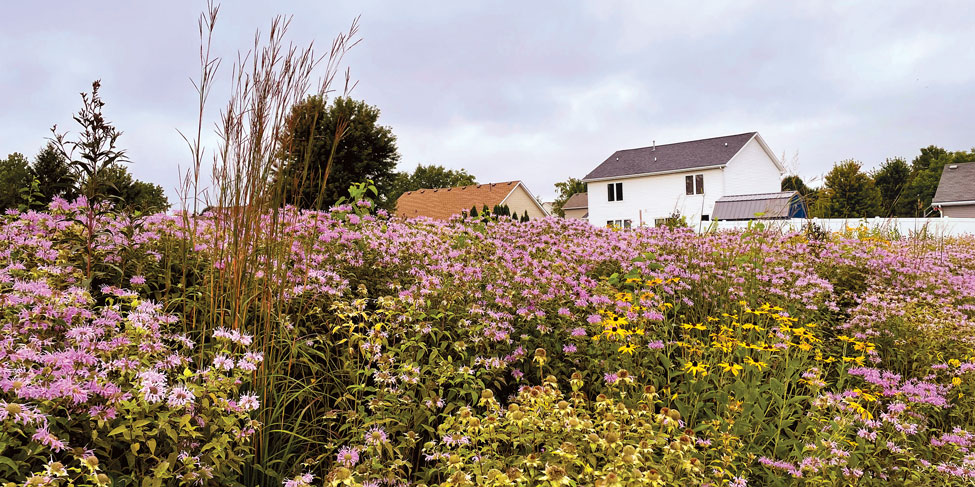
Photo courtesy of Cassie Druhl from Polk County
Healthy soils function like sponges, absorbing water more effectively. “Sponge farming is an agricultural twist on sponge cities,” Stevenson adds. Sponge cities imitate natural ecosystems in their approach to rainwater management. Cedar Rapids promotes rain gardens and other clean-water solutions.
“We want to keep going with this watershed partnership approach to improve water quality for everyone,” says Stevenson, who received the 2023 IAWA Public Impact Award for her partnership efforts.
 Local Efforts Lead to Big Results
Investing in watershed-wide partnerships helps accelerate positive change. Consider the Central Iowa Clean Water Partnership (CICWP), which includes Ducks Unlimited and the IAWA. CICWP has invested nearly $1 million in constructing wetlands and improving water quality since 2022.
Strategically placed wetlands can remove up to 90% of nitrates from farmland drainage. Multiple wetlands have been installed on farms and urban areas, Jones says. This includes the 8,388+ acre Chichaqua Bottoms Greenbelt in northeast Polk County.
All these efforts offer a powerful reminder: protecting water begins close to home. Jones likes a compelling quote from the late Jane Goodall, the renowned conservationist who challenged the “think globally” mindset.
“If you think globally, you will become filled with doom. But if you take a little piece of this whole picture… this is what I can do here…gradually the pieces get filled in, and the world is a better place, because of you.”