The Other 364 Days of Turkey
November 11, 2026
By April Pearson
Thanksgiving is the turkey's big moment in the spotlight, but ensuring turkey is available year-round is a year-round operation. From Iowa farm families to your family’s fabulous feast, let’s talk turkey!
Turkey All the Time
Sheila Larson is the vice president of communications and membership for the Iowa Turkey Federation. She’s also a turkey farmer near Ellsworth who, with her family, raises about 160,000 birds each year.
From hatchery to farmer to processor to purchaser, all parties must work together to ensure a steady supply of turkey all year. “It's a balancing act for the processing plants to ensure they have enough poundage every week to deliver all the products they need to,” says Larson.
So they work backward.
First, the processor and farmer agree on processing dates for the year. Then the farmer counts back 18-20 weeks (the time it takes turkeys to reach 45 pounds) and tells the hatchery the dates they’ll need poults. From there, the hatchery sets up its schedule, allowing for a 28-day egg incubation period, to make sure it has enough turkey eggs for all its customers and enough hatching space. “It’s really just communication across the entire industry to make sure that all the dates line up and there aren’t any hiccups,” she says.
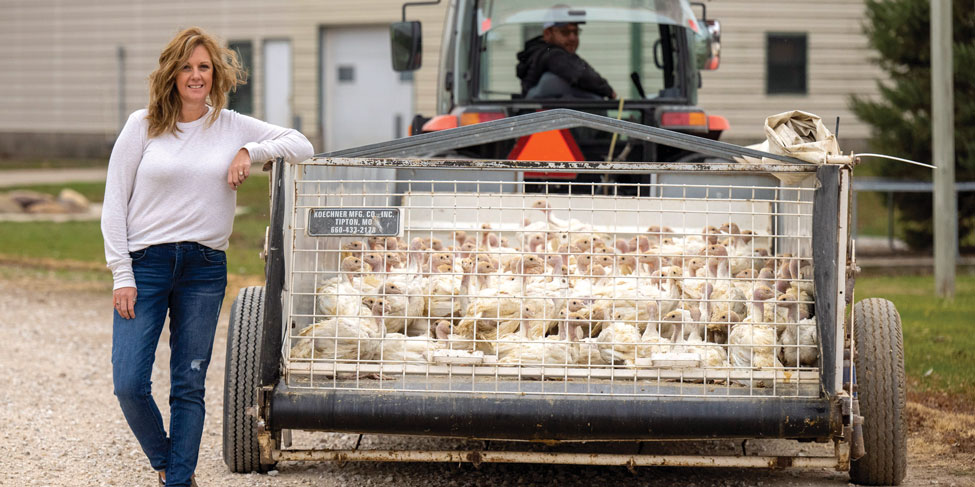 Sheila Larson and her husband on their turkey farm in Hamilton County.
Photo courtesy of Iowa Farm Bureau
Raising Turkeys Right
The Larsons get their poults from the Osceola hatchery, plus hatcheries in Minnesota and Canada, depending on the breed they want. They have three locations, and each location raises three flocks per year.
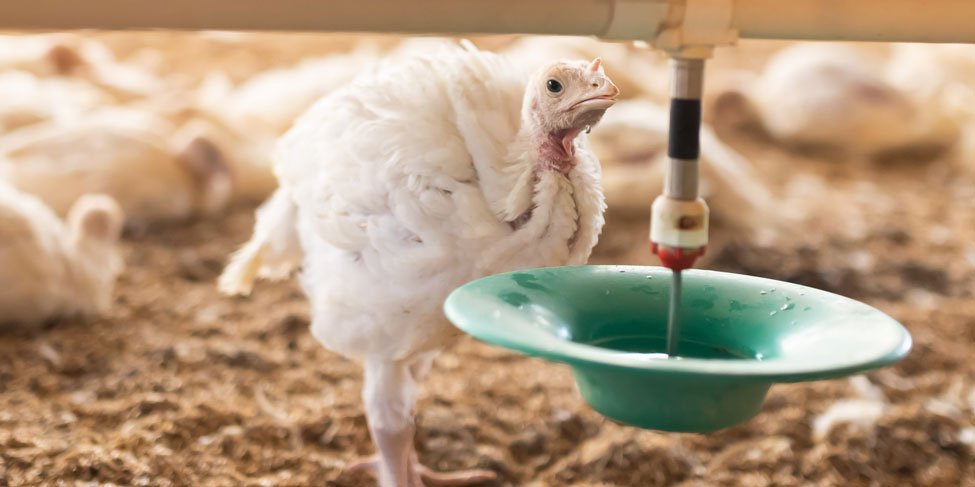
“Once we started raising turkeys year-round, the need for barns came into play,” Larson says. “We live in Iowa. We get rain and snow, and it gets very hot and very cold. Turkeys don’t like to be very hot or very cold.” The barns allow the family to control temperature and ventilation. They even have misters and fans to keep the birds cool.
The family’s modern operation also includes a monitoring system that sounds a phone alarm if a barn’s temperature is too high or low. “Technology is awesome, and has helped keep our birds healthier. You are always on call,” she says. “The alarm will go off at two or three in the morning, so what do you do? Adjust equipment from your phone — go to the barn, so the turkeys are comfortable.”
The Larsons are independent farmers, but there are contract farmers too. The difference is that independent farmers own everything and take all the risks. “We own the farm, we buy the poults, we pay for feed and medicine — we take care of all of it, and we have a contract with the processor to buy our birds,” says Larson. By contrast, a contract farmer owns their farm, but the processing plant owns the birds, pays for food and medicine, and pays the farmers to raise the turkeys.
 Satiety, Safety and Security
The Larsons’ turkeys are kept comfortable and well-fed, with nutritionists ensuring they eat a balanced diet of corn, soybeans, vitamins, minerals and fat. “Our turkeys eat very healthy because they have nutritionists constantly adjusting their diets based on age, growth and weight,” says Larson. “If we notice anything off, we call the nutritionist.”
Another important part of turkey health and safety? Biosecurity. The Larsons use the Danish Entry System, which involves a physical line of separation — usually a bench — between “dirty” and “clean” areas right inside the entry door. Farmers sit on the bench to remove their regular boots, then swing their legs over to put on designated barn boots and coveralls. This reduces the likelihood of tracking outside microorganisms into the barn. Larson says, “It’s about keeping outside things out and inside things in.”
No Paltry Poultry Parts
Every part of the turkey is used. Thighs become hams and bacon. Stores also carry tenderloins, breast roast, ground turkey, deli meat and whole turkeys. Drumsticks can be found at carnivals, Renaissance fairs and amusement parks. They use the bones to make bone broth and bone meal for animal feed, and they export the feet to China. Larson says, “There’s even a company in Arkansas that uses the turkey feathers for masquerade masks and feather boas, so that's cool.”
Turkey Trivia
· The U.S. is the largest producer of turkey in the world.
· Iowa is seventh in the nation for turkey production, raising 12 million per year.
· Iowa is sixth in the nation for turkey processing, processing 15.5 million per year
· There are 130 turkey-farming families and 38,000 industry jobs in Iowa.
· Turkey production creates $10.64 billion in economic activity in Iowa.
· Turkey is naturally low in fat and a good source of iron, zinc and B vitamins.
· A baby turkey is called a poult; a female turkey is a hen, and a male turkey is a tom.
Going Whole Hen
If you’re preparing a whole turkey for Thanksgiving, it probably came from Minnesota. “In Iowa, we only raise toms, those 45-pound birds,” says Larson. “No one's putting a 45-pound bird into their oven. I don't know if it would even fit in the oven, to be honest. What you're enjoying when you have a whole bird is a hen. And Minnesota is number one in the nation for turkey production, so a lot of hens would be coming from Minnesota.”